spine trauma radiology facet dislocation subluxation perched locked ct imaging radedasia

Stay tuned on new Fellowships and learnings

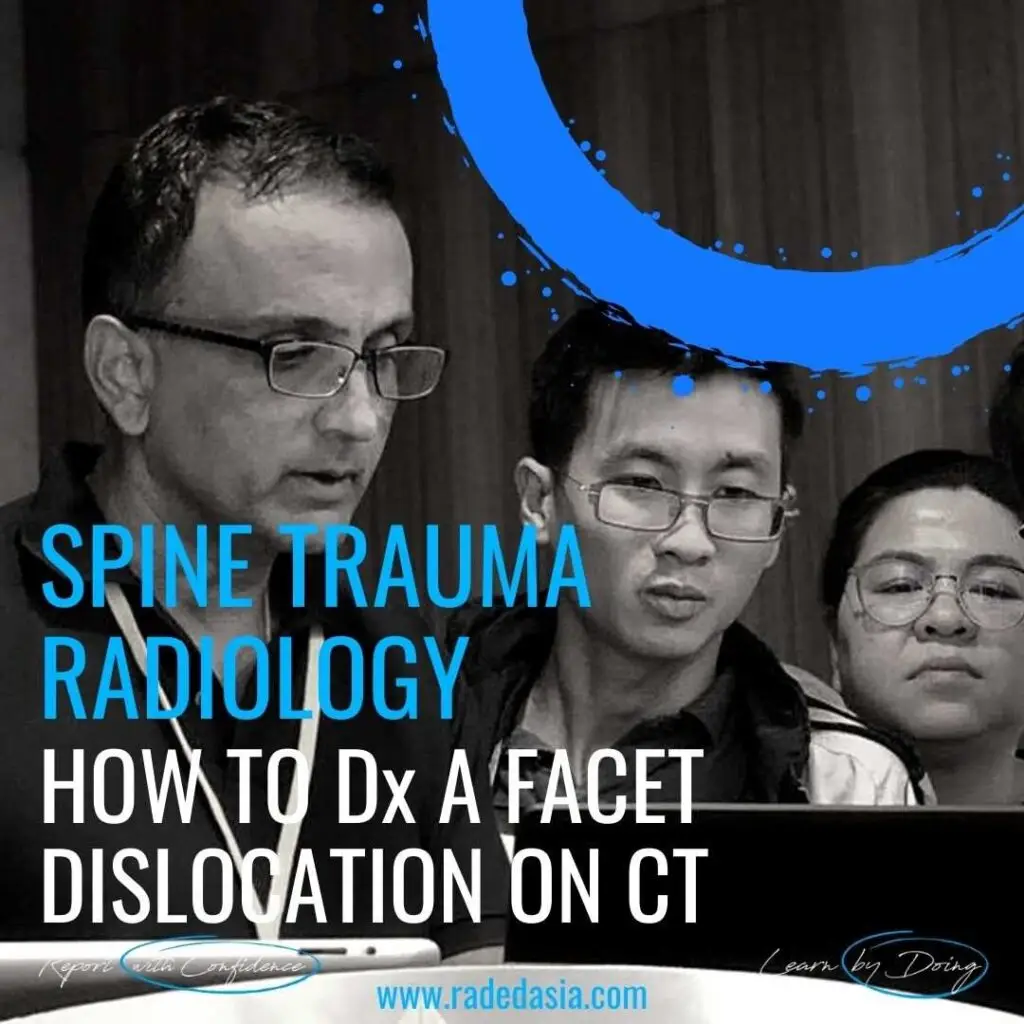
SPINE TRAUMA RADIOLOGY: HOW TO Dx A FACET DISLOCATION ON CT (VIDEO)

SPINE TRAUMA RADIOLOGY: FACET DISLOCATION ON CT

Facet joint trauma is a spectrum, not a single injury — here's where dislocation sits on it

  • Facet joint injury in spinal trauma ranges from diastasis, to subluxation, to perched facets, to complete dislocation.
  • Recognizing the normal facet joint appearance is the reference point for spotting displacement further along that spectrum.
  • In this video we walk through the normal facet joint at C7-T1, then contrast it with a complete facet dislocation at C6-C7.

If you find the video helpful, please subscribe to the channel.

THE SPECTRUM OF FACET JOINT INJURY
  • Diastasis — widening of the facet joint space.
  • Subluxation — partial loss of the normal articular alignment.
  • Perched facet — the inferior articular process sits balanced on the tip of the superior articular process below, short of full dislocation.
  • Dislocation — complete loss of articulation, with the inferior articular process displaced anteriorly and uncovering the joint.
NORMAL VS DISLOCATED FACET JOINT APPEARANCE
  • At the C7-T1 level, the joint is formed by the inferior articular process of C7 and the superior articular process of T1.
  • The space between these two processes is the facet joint.
  • Normally, the inferior articular process lies posterior to the superior articular process below it, maintaining the joint space.
  • At the level above, the joint is formed by the inferior articular process of C6 and the superior articular process of C7.
  • Here, the inferior articular process of C6 lies anterior to the superior articular process of C7, rather than sitting at the normal joint position.
  • This produces uncovering of the joint — anterior movement of the inferior articular process off the superior articular process below it.
  • This appearance represents complete dislocation of the facet joint.
KEY POINT
  • Facet joint trauma spans a spectrum: diastasis, subluxation, perched facets, and dislocation.
  • A normal facet joint has the inferior articular process of the vertebra above lying posterior to the superior articular process of the vertebra below, with the joint space preserved.
  • Complete facet dislocation shows the inferior articular process displaced anteriorly, uncovering the joint entirely.
  • Knowing the normal facet position is what lets that anterior uncovering be recognized as dislocation rather than a lesser injury on the spectrum.
TEST YOURSELF ON SOME COMMON & FREQUENTLY ASKED QUESTIONS
Diastasis, subluxation, perched facets, and dislocation — increasing degrees of facet joint disruption.

The inferior articular process of the vertebra above lies posterior to the superior articular process of the vertebra below, with the joint space maintained between them.

Anterior movement of the inferior articular process relative to the superior articular process below it, uncovering the facet joint.

It's the reference point. Anterior displacement and uncovering of the joint can only be recognized as abnormal against the normal posterior position of the inferior articular process.

VIEW VIDEO ON FACET DISLOCATION ON CT

Our CPD & Learning Partners

Learn more about this condition & how best to report it in more detail in our SPINE & SIJ Imaging Mini Fellowships.

Click on the image below for more information.

OTHER POPULAR POSTS ON SPINE MRI: CLICK ON THE IMAGE BELOW

Facet Joint
ct mri facet cysts mri spine how to mri facet cysts spine learn spine mri online radiology education asia
Facet Joint

Stay tuned on new Fellowships and learnings

error: Content is protected !!

Join our Newsletter

Stay tuned on new
Mini-Fellowships launches and learnings

Mini-Fellowships

Better Than Conferences

Join our WhatsApp Community

We help radiologists learn
by doing and report with confidence

This site is intended for Medical Professions only. Use of this site is governed by our Terms of Service and Privacy Statement which can be found by clicking on the links. Please accept before proceeding to the website.